Why Does the Black Sea Turn Milky Blue Every Summer?
NASA says a recurring bloom of microscopic phytoplankton called coccolithophores is behind the Black Sea's yearly shift from dark blue to a pale turquoise shade.
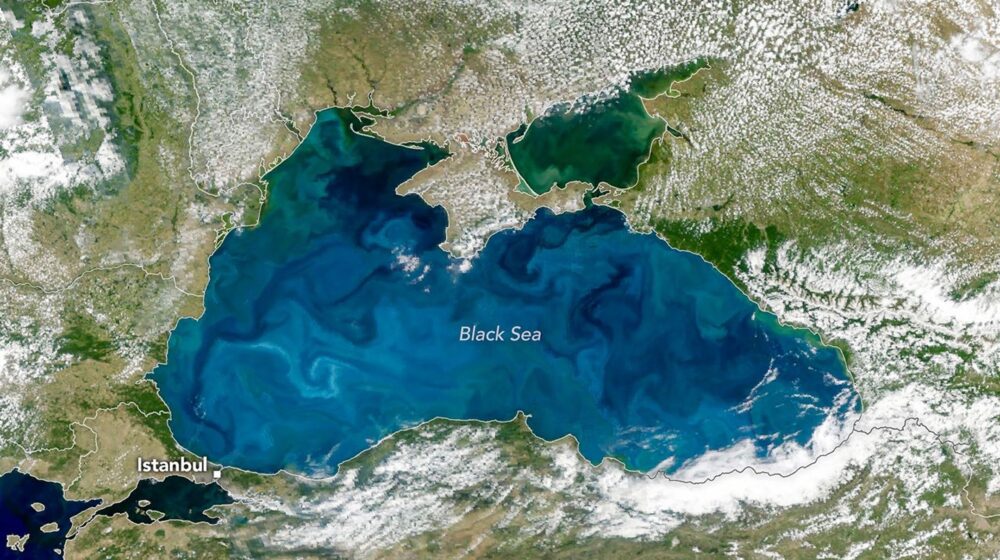
Every year, for a few weeks in late spring and early summer, the Black Sea sheds its usual dark appearance and takes on a pale, milky-turquoise shade that is visible even from space. NASA’s PACE satellite recorded the latest example of this shift on 22 June 2026.
The image, taken by the Ocean Color Instrument aboard the PACE mission, showed wide bands of turquoise water spreading across the Black Sea’s surface, shaped by the currents beneath. NASA scientists say the change is caused by blooms of coccolithophores, tiny phytoplankton covered in plates made of calcium carbonate.
When these organisms multiply rapidly, their reflective plates scatter sunlight and turn the water a milky, pale colour. Individually, the organisms are invisible to the naked eye, but together they can colour enormous stretches of ocean.
The effect is not limited to the open sea. On 27 May 2026, roughly a month before the PACE image, an astronaut aboard the International Space Station photographed the same kind of turquoise bloom tracing currents through the Bosphorus strait in Istanbul, which links the Black Sea to the Sea of Marmara.
Later in the year, the Black Sea’s colour shifts again as diatoms, a different type of phytoplankton with silica-based shells, become more common. Unlike coccolithophores, diatoms tend to darken the water rather than brighten it.
NASA says these seasonal colour changes reflect shifts in biological activity within the sea, not any change in the water itself, and that tracking the blooms from orbit helps scientists study marine ecosystems across areas that would otherwise be difficult to monitor.
NASA Earth Observatory/by Michala Garrison



Leave a Reply