Sikkim’s Skilled Youth Start Up Scheme: who qualifies for up to 50% loan subsidy
Sikkim's Skilled Youth Start Up Scheme offers unemployed youth aged 18-45 a bank loan with a back-ended subsidy of 35-50% to launch approved businesses.
Unemployed youth in Sikkim between the ages of 18 and 45 can now apply for a state-backed startup loan carrying a back-ended subsidy of up to 50 percent, under a scheme run by the state’s Commerce and Industries Department. The Skilled Youth Start Up Scheme is aimed at educated but unemployed residents who want to launch a business in sectors ranging from dairy and poultry to tourism, IT services, tailoring and automobile workshops, with project costs covered running as high as ₹20 lakhs depending on the category chosen.
To qualify, an applicant must hold a Certificate of Identification, a Sikkim Subject Certificate, or a Residential Certificate for those in urban areas, and must have completed at least Class V at a recognized school. Anyone proposing a technical, manufacturing or service-based venture additionally needs a certificate from a recognized technical institute. Only one person per family can apply, and the applicant’s family income must not exceed ₹8 lakhs a year; for married applicants that family unit includes a spouse and children, while for unmarried applicants it includes parents and unmarried siblings. Children of government employees are eligible only if the parent holds a Group ‘C’ or Group ‘D’ post. Applicants must also be free of any default with a nationalized bank, financial institution or co-operative bank, must hold a valid trade license for the proposed business, and must not have previously received a subsidy under the CMSS or PMEGP schemes. Persons with Disabilities are given priority consideration and can access a 50 percent subsidy.
The subsidy structure itself is tied to income category: applicants below the poverty line receive back-ended support of 50 percent of the project cost, while all other eligible applicants receive 35 percent, with the balance financed through a bank loan. The maximum admissible project cost varies widely by sector, from ₹3 lakhs for organic farming ventures to ₹20 lakhs for diagnostic centres and film-related projects, and applicants are required to contribute between 5 and 15 percent of the total cost themselves, according to individual bank norms.
Applying starts with submitting the prescribed application form, listed as Annexure-I, along with a Detailed Project Report and the required supporting documents to the General Manager at the District Industries Centre in either Gangtok or Jorethang. A Selection Committee made up of departmental officials and bank representatives reviews each application before forwarding approved projects to a bank for loan sanctioning. Before any loan is disbursed, selected applicants must complete a mandatory three-day Entrepreneur Development Training. Documents required alongside the application include two passport-sized photographs, proof of Sikkim residency, educational certificates, a birth certificate or panchayat certification, a verified project report in two copies, a voter ID card, an unemployment card from the relevant Block Administrative Centre, a land lease agreement or land parcha where applicable, a BPL certificate from DESME if relevant, an income certificate from the BDO or SDM, and a No Objection Certificate from SABCO or SIDICO.
Loan repayment, including interest, remains the sole responsibility of the beneficiary as per the terms set by the financing bank. Beneficiaries in agriculture and allied activities can close their loan account early after one year with departmental approval, while other project categories carry a three-year lock-in period. The scheme’s guidelines also warn that inflating a project’s cost purely to secure a larger subsidy will disqualify an application from committee approval.
The Skilled Youth Start Up Scheme is administered by the Government of Sikkim’s Commerce and Industries Department. Source: myscheme.gov.in
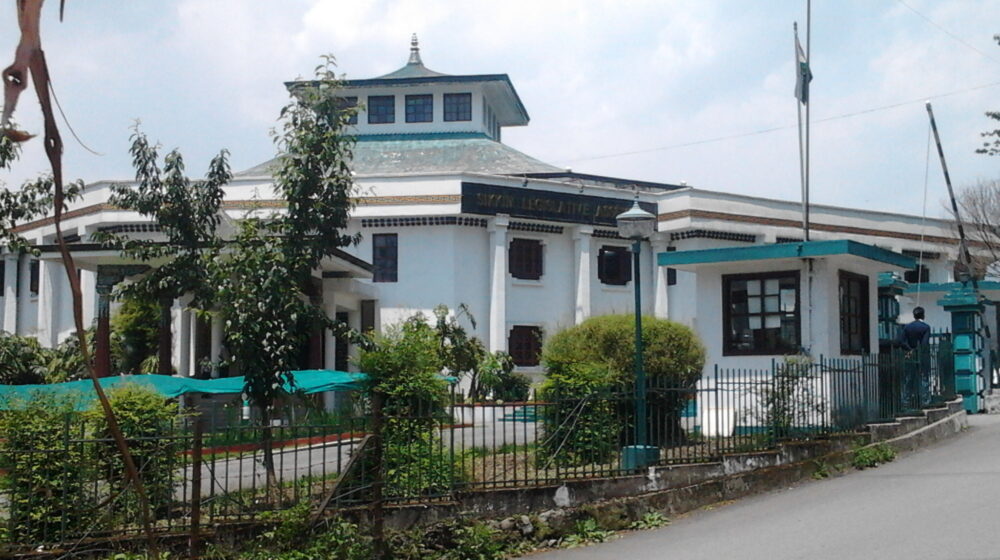
Sikkim Legislative Assembly building, Gangtok. Wikimedia Commons/by Srikanthkashyap
Leave a Reply