Bhubaneswar hosts national workshop on FMD-free zones, compartments for livestock
The Department of Animal Husbandry & Dairying held a two-day national workshop in Bhubaneswar to plan compartmentalization and zoning strategies against Foot & Mouth Disease.
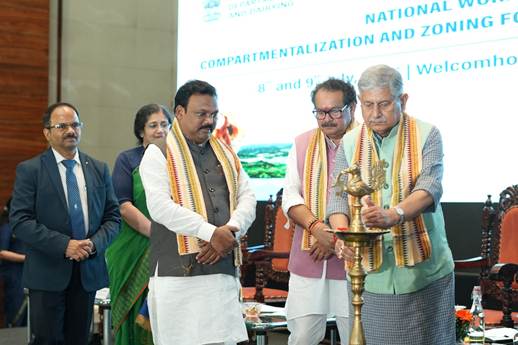
The Department of Animal Husbandry & Dairying (DAHD), under the Ministry of Fisheries, Animal Husbandry & Dairying, opened a two-day National Workshop on Compartmentalization and Zoning for Foot & Mouth Disease (FMD) on 8 July 2026 in Bhubaneswar, Odisha. The workshop is intended to align India’s animal health system with international standards for compartmentalization and zoning, accelerate FMD control and eradication, enable safer trade in livestock and livestock products, and support the national target of FMD-free status by 2030.
The inaugural session began with the ceremonial lighting of the lamp by Union Minister Shri Rajiv Ranjan Singh, also known as Lalan Singh, who holds the Fisheries, Animal Husbandry & Dairying portfolio. He was joined by Minister of State Prof. S. P. Singh Baghel, Odisha’s Fisheries & Animal Resources Development Minister Shri Gokulananda Mallik, DAHD Secretary Shri Naresh Pal Gangwar, Additional Secretary Ms. Varsha Joshi, Additional Secretary Shri Rama Shankar Sinha, and Animal Husbandry Commissioner Dr. Naveena B. Maheswarappa.
During the inaugural session, the Union Minister launched four digital initiatives: the Rate My Laboratory App, funded under the Pandemic Fund to allow real-time feedback on veterinary diagnostic labs; the Dairy Vikas Portal, a centralized system for tracking milk collection infrastructure such as Bulk Milk Coolers and Milk Collection Centres; and the Vidyapeeth Portal, which manages trainee records and QR-based certification for Artificial Insemination Training Institutes. He also released a Standard Operating Procedure folder and video on preventing and controlling mastitis in dairy animals.
Shri Rajiv Ranjan Singh noted that the livestock sector contributes about 31% of Agricultural Gross Value Added and nearly 5.5% of India’s total GVA. He said NSP positivity for FMD has fallen from 16.6% in 2022 to 7.8% in 2026, more than 1.4 billion vaccine doses have been given under the programme, no Asia-1 serotype case has surfaced in three years, and India can now produce 116 crore FMD vaccine doses annually. Nine states have been marked as priority states for establishing FMD-free zones and compartments.
Prof. S. P. Singh Baghel highlighted the sector’s support for over 8 crore rural families, particularly women, while Odisha minister Shri Gokulananda Mallik stressed that sustained vaccination, surveillance, biosecurity and veterinary infrastructure are essential to reach FMD-free status by 2030. DAHD Secretary Shri Naresh Pal Gangwar spoke on the role of compartmentalization and zoning in strengthening India’s disease-control efforts.
The first technical session covered WOAH standards for establishing FMD-free zones and compartments, along with a review of the Support to States/UTs for Capital Investment (SASCI) Scheme. Additional Secretary Ms. Varsha Joshi flagged the need to prepare for El Niño’s potential impact on fodder supply, urging states to set up Fodder Task Forces and district-level contingency plans. The workshop continues on 9 July 2026 with sessions on differential FMD control strategies, negative marker vaccines, and emerging SAT serotype threats.

Leave a Reply